The 90-Minute Pantheon + Piazza Navona Route Locals Actually Use
The Pantheon and Piazza Navona are less than 500 meters apart. Locals cross this distance daily—to work, to buy groceries, to attend Mass. This 90-minute walk follows their actual routes, not a tourist circuit.
The walk isn’t a tourist invention—it’s a stretch of pavement Romans cross dozens of times per week. You pass corner bars where espresso flows at the counter, Renaissance palazzi with hardware stores on the ground floor, and parish churches holding midday Mass. Stop at corner bars for espresso (€1.50 at the counter, not €5 at a table), use the same shortcuts delivery drivers use, and avoid the tourist cafés ringing Piazza Navona—this is actual behavior, not abstraction.
Why This Route Works: Geography, Heritage, and Everyday Use
The Pantheon in Piazza della Rotonda and Piazza Navona lie entirely within the UNESCO Historic Centre of Rome, a World Heritage property recognized for continuous urban layering from antiquity through papal Rome to today.
Medieval streets sit directly over Roman ones, and current residents walk atop buried layers. Via della Dogana has Roman foundations but medieval facades. Sant’Agnese in Piazza Navona was rebuilt in the 1650s. The entire zone is protected, but not every street has significance—some are just narrow and cramped.
It’s walkable, but scooters and tourists cluster near the Pantheon; stick to the side streets if you want to avoid bottlenecks. Watch for residents stopping at the alimentari on Via della Palombella between 1–2 p.m., when locals grab bread before heading home for lunch. Because the Pantheon is an active basilica—Santa Maria ad Martyres—managed by Italy’s Ministry of Culture, and the surrounding streets host shops, municipal offices, and cafés, foot traffic here reflects real Roman life, not just sightseeing.
Allocate 90 minutes if you want to stop inside the Pantheon, take photos, and duck into one or two side streets. This isn’t a sprint through checkboxes; it’s a rhythm that accommodates both monumental encounters and the small pauses that make city walking functional and enjoyable.
Starting Point: The Pantheon and Piazza della Rotonda
The Pantheon is located in Piazza della Rotonda (00186 Rome) and managed by the Direzione Musei Statali di Roma under the Italian Ministry of Culture. This placement at the heart of the centro storico makes it an inevitable hub for anyone walking Rome’s historic core, whether they’re visiting the monument or simply crossing the square en route to somewhere else.
 Photo: Rabax63 / Wikimedia Commons, CC BY-SA 4.0 (cropped)
Originally built by Marcus Agrippa around 27 BCE as a temple for all Roman gods, the current rotunda and dome were completely rebuilt by Emperor Hadrian between 118 and 128 CE. The oculus (hole in the center of the dome) floods the interior with light and acts as a clock—watch the sunbeam move across the floor as time passes.
As an active basilica, the Pantheon opens daily from 09:00 to 19:00 (last entry 18:30), but opening hours can vary during religious services—Mass or major holidays may pause tourist access. Turismo Roma explicitly warns that liturgical functions can modify visiting conditions, so planning around typical service times (early morning or late afternoon on weekdays) helps avoid surprises.
Visitors should respect church customs: silence, appropriate dress (covered shoulders and knees), and awareness that you are entering a functioning place of worship, not just a monument. The Ministry of Culture identifies it as the Basilica di Santa Maria ad Martyres, meaning decorum expected in any Roman church applies here.
Piazza della Rotonda itself is a busy local square with cafés, newspaper kiosks, and residents crossing on their way to work or services. Sit at a bar for five minutes and watch: tourists line up at the main entrance; locals walk straight through the square to the post office or side streets; neither group acknowledges the other.
The 500-Meter Walk: What the Route Actually Looks Like
The Pantheon and Piazza Navona are less than 500 meters apart, connected by narrow, medieval-plan streets within the UNESCO Historic Centre. Typical routes leave Piazza della Rotonda heading west or northwest, passing through small piazzas, past churches, and along via alleys used by delivery scooters, residents with shopping bags, and office workers.
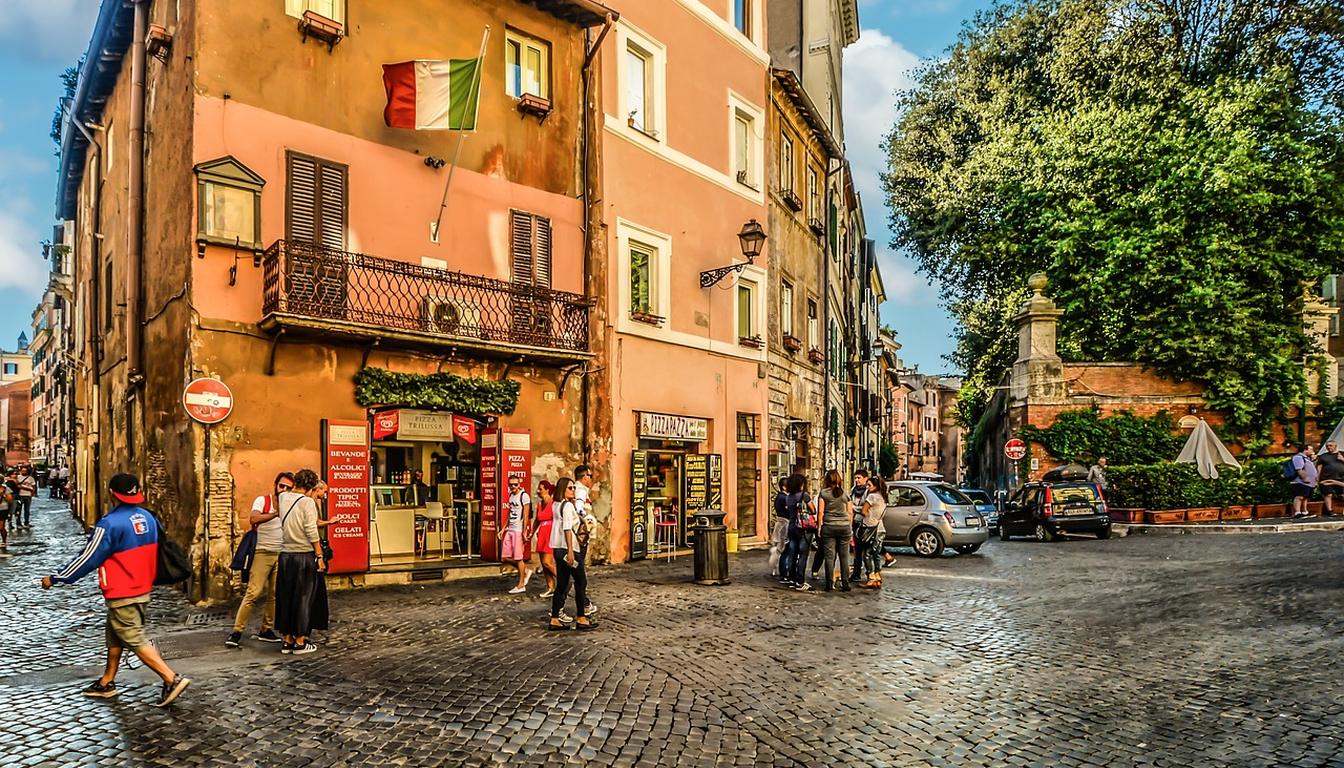
You pass hardware stores (Ferramenta on Via dei Cestari), family-run groceries, and a print shop before you reach a single souvenir stand. The tourist economy hasn’t colonized every corner. Ground-floor windows display everything from religious vestments to plumbing fixtures, reflecting the centro storico’s status as a working neighborhood where heritage protection coexists with contemporary commerce.
Wear good shoes—cobblestones and uneven paving are relentless. Medieval streets are narrow; step into doorways when scooters or delivery vans come through. Locals move through this grid dozens of times per week, so follow their pace, not a tourist’s.
Navigation is intuitive—streets generally trend northwest from the Pantheon toward Piazza Navona—but pulling out a map or phone to confirm direction is standard practice for locals and visitors alike. Detour down Via del Teatro Valle to see a 17th-century courtyard or cut through Piazza Sant’Eustachio if you want to avoid the main tourist flow. Skip the side streets near the Trevi area—they’re packed with tourist shops.
Key Stops and Everyday Landmarks Along the Way
Between the two squares, the route passes smaller piazzas—often with a fountain or church—that locals use as meeting points or shortcuts. These small piazzas are where locals meet friends, sit to check their phone before heading to the next errand, or catch their breath during the walk.
 Photo: Gobbler / Wikimedia Commons, CC BY-SA 3.0 (cropped)
Small churches along the way hold regular Mass and parish activities; you may see residents entering for midday prayer or community events. Unlike the Pantheon’s constant tourist flow, these parish churches operate in relative quiet, their schedules posted on doors announcing daily liturgies, confessions, and feast-day celebrations that structure local religious life.
Look for corner bars (caffè) where Romans grab espresso standing at the counter—these are natural brief stops on a local-paced walk. Prices drop significantly when you stand rather than sit, and the ritual of ordering, drinking, and leaving in under five minutes mirrors the rhythm locals maintain throughout their day. Watch a barista hand an espresso to a regular without taking an order, or overhear a postal clerk joke with a customer—these small courtesies show you who belongs in the neighborhood and who’s passing through.
Craft workshops, bookbinders, and antique-restoration studios occupy ground-floor spaces, part of the centro storico’s artisan fabric. Peering through windows reveals workbenches cluttered with tools, gilding materials, or leather-bound volumes in various states of repair. The city technically protects these workshops, though most operate quietly and could vanish if a developer buys the building. They survive because the owners are old and haven’t sold—not because laws alone protect them.
Marble plaques mark street corners—Risorgimento dates, papal decrees, names of people who died in WWII. Stop and read three or four during your walk; they tell a story faster than any guidebook.
Arriving at Piazza Navona: Layout and Local Context
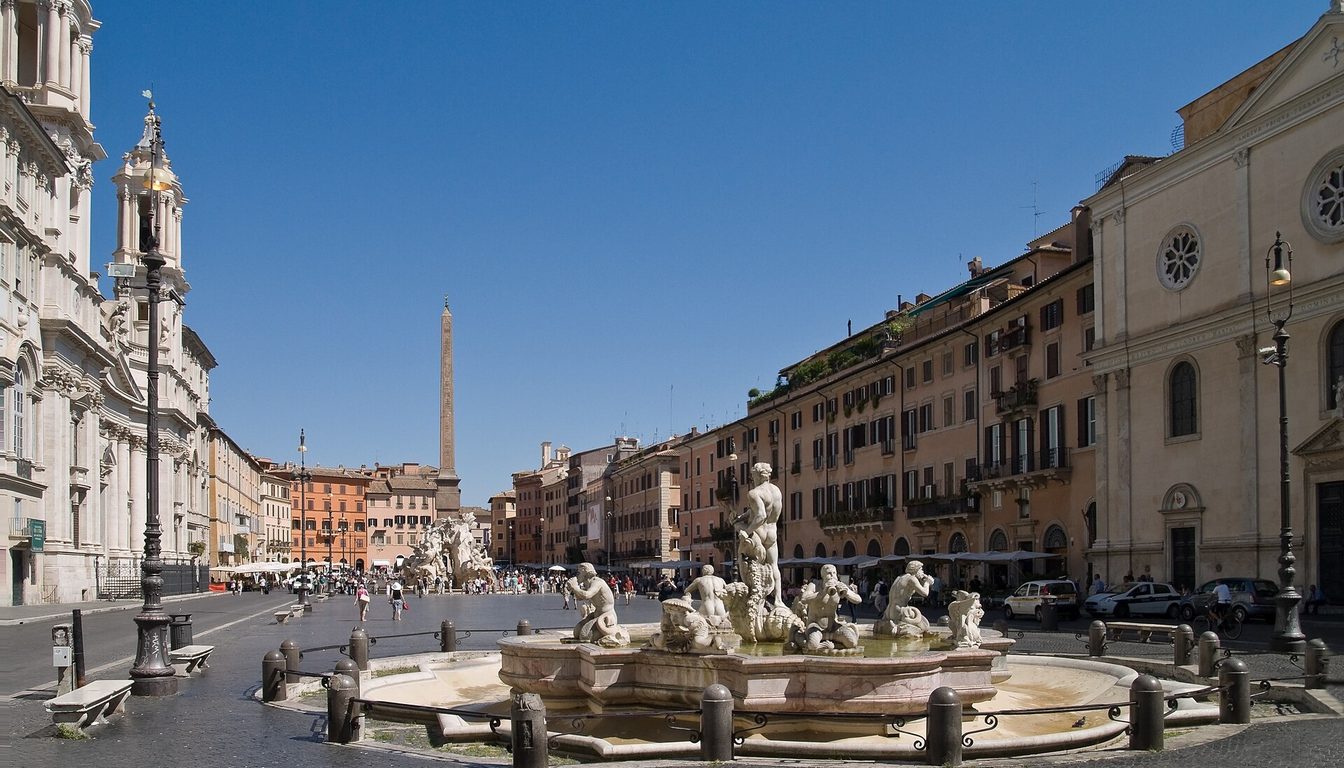
Piazza Navona occupies the footprint of the ancient Stadium of Domitian, maintaining the elongated oval shape of the original 1st-century athletics venue. The moment you exit the narrow streets into Piazza Navona, you stop squinting. The open light and wide pavement feel sudden—your shoulders relax because no scooter is about to clip you.
The piazza is bounded by Baroque palazzi, three major fountains (including Bernini’s Fontana dei Quattro Fiumi), and the church of Sant’Agnese in Agone. The three fountains are a Baroque arms race—each pope wanted his family’s fountain biggest and flashiest. Now they’re just tourist backdrops, and residents ignore them.
While heavily visited, Piazza Navona is also a residential address; local families live in apartments above the cafés and souvenir stands. Laundry occasionally hangs from upper-floor windows, and evening hours reveal residents returning home with groceries, navigating the tourist crowds with practiced efficiency.
Romans use the piazza as a through-route on foot or bike, a place to meet friends before dinner, or a spot for children to play while parents chat nearby. The open space functions much like any urban plaza—functional, social, and layered with daily routines that persist regardless of visitor numbers.
Because it is part of the UNESCO Historic Centre, the square balances tourist activity with everyday urban functions protected under heritage regulations. Municipal authorities manage the tension between commercial pressure (outdoor café seating, street performers, souvenir sellers) and preservation priorities, a negotiation visible in the controlled density of tables and restrictions on vehicle access that keep the piazza pedestrian-focused.
Timing, Rhythm, and Practical Logistics for 90 Minutes
A realistic 90-minute window includes 20–30 minutes inside the Pantheon, 10–15 minutes for the walk itself, and the remaining time for brief stops, photos, or a coffee. This pacing assumes moderate walking speed, pauses to orient yourself, and at least one short detour to peek inside a church or stop at a bar counter.
Best time to visit:
- Early morning or late afternoon on weekdays to avoid Pantheon Mass times and lighter crowds
- Mid-morning or early evening for uninterrupted basilica access during lower congestion
- Off-season (November–February, excluding holidays) for fewer tourists while locals’ rhythms remain steady
- Avoid major feast days when religious services may restrict tourist entry
- Evening hours reveal residential life—locals returning home, laundry visible, genuine neighborhood activity
Costs at a glance:
- Budget tier: Standing espresso at a corner bar counter; free entry to small parish churches; drinking-fountain water
- Mid-range tier: Table service at outdoor cafés in the piazza; brief church visits with small donations; gelato or pastry from local bakeries
- Premium tier: Extended café seating in Piazza Navona; paid museum-level guidebooks or art books at artisan shops; restaurant meals near the squares
Plan your visit slightly outside typical Mass times (early morning or late afternoon on weekdays) to avoid temporary closures or crowding at the Pantheon. Turismo Roma notes that opening hours may vary during religious services, so aiming for mid-morning or early evening increases the likelihood of uninterrupted access while also catching the area during less congested pedestrian hours. For Pantheon Roma ticket details and current access conditions, consulting advance information helps manage timing around liturgical schedules.
The route is manageable for most mobility levels, though cobblestones and steps at church entrances may challenge wheelchair users or strollers; accessible routes exist but require planning. Rome’s historic streets weren’t designed with contemporary accessibility standards, so consulting municipal resources or mapping apps with accessibility filters helps identify smoother paths through the centro storico.
Public transport serves both squares via several city bus routes, making it easy to start or end the walk from other parts of Rome. Major bus lines stop near the Pantheon and within a short walk of Piazza Navona, connecting the Historic Centre to neighborhoods like Trastevere, Prati, or Testaccio without requiring metro transfers.
Public transport serves both squares via several city bus routes, making it easy to start or end the walk from other parts of Rome.
Locals often combine this route with other errands—stopping at a pharmacy, post office, or market—so don’t feel rushed; the area rewards a slower, observant pace. The 90-minute framework is a practical guide, not a rigid schedule, and adapting it to include a detour for fresh pasta or a particular bookshop reflects how Romans actually use these streets.
For practical transit detail in Rome, see How to get around Rome using public transport: a complete guide.
Common Misconceptions and What to Expect in Practice
Many visitors assume the Pantheon is only a museum, but it is an active basilica where Mass is celebrated and religious life continues; tourist access can pause during services. The Ministry of Culture’s official designation as the Basilica di Santa Maria ad Martyres makes its religious function legally and functionally primary, with cultural tourism accommodated within that framework.
 Photo: John Samuel / Wikimedia Commons, CC BY-SA 4.0 (cropped)
The area between the Pantheon and Piazza Navona is not a separate tourist district but part of the UNESCO World Heritage property, meaning heritage protections and living urban use coexist. The Sovrintendenza Capitolina’s documentation confirms that this entire stretch falls within the protected centro storico, where regulations balance preservation, residential rights, and commercial activity.
Locals do not ‘tour’ this route in a linear, timed fashion; they cut through, stop for coffee, run errands, or meet friends, so the 90-minute framework is an adaptation for visitors, not a fixed local habit. Romans might walk from the Pantheon to Piazza Navona in under ten minutes without stopping, or spend an hour doing the same distance if they’re catching up with a neighbor or browsing a shop window.
You can always access the Pantheon during posted hours, but religious services may alter conditions; check ahead if your schedule is tight. The basilica’s dual identity means that on major feast days or during special liturgies, tourist entry may be restricted or redirected, prioritizing worshippers over sightseers.
The route’s value lies in experiencing the blend of monumental heritage and everyday life, not in ticking off a checklist of sights. If you approach the walk as functional infrastructure—a way to move through Rome’s historic core while absorbing its layered reality—you’ll understand why locals return to these streets daily without ever treating them as a ‘route’ at all.
Tips for Walking Like a Local (Without Acting Like One)
Use the Pantheon’s central location as a hub for short walks to other nearby squares, leveraging the dense concentration of heritage in the centro storico. From Piazza della Rotonda, you can reach Campo de’ Fiori, Piazza Venezia, or the Trevi Fountain on foot in under twenty minutes, making the Pantheon an efficient anchor point for exploring multiple areas in a single morning or afternoon.
Stop for espresso at a corner bar rather than a table-service café; standing at the counter is faster, cheaper, and how locals caffeinate mid-route. The price difference between bar and table service can be threefold, and the standing ritual—order, drink, pay, leave—integrates you into the neighborhood’s working rhythm rather than the tourist leisure economy.
Dress appropriately for entering the Pantheon and any other churches along the way—covered shoulders and knees—and maintain decorum inside. Carrying a light scarf or shawl allows quick adjustments if you’re dressed for warm weather but want to step inside for a brief visit, respecting both church norms and the cooler interior temperatures.
Carry a refillable water bottle; Rome’s drinking fountains (nasoni) are scattered throughout the Historic Centre and used by residents daily. These cast-iron fountains provide continuous potable water, and knowing how to use them—plug the main spout with your finger to redirect flow through the upper hole for easier drinking—marks you as someone familiar with Roman infrastructure.
Carry a refillable water bottle; Rome’s drinking fountains (nasoni) are scattered throughout the Historic Centre and used by residents daily.
Walk at a moderate pace, stay aware of scooters and bikes on narrow streets, and step aside in doorways or small piazzas to consult maps or take photos, keeping pedestrian flow smooth. Romans walk with purpose even when they’re not in a hurry, and matching that steady rhythm helps you blend into the neighborhood’s movement rather than interrupting it. When you need to pause, moving out of the main pedestrian line—into a doorway recess or against a building façade—shows spatial courtesy that locals practice automatically.
For a full multi-day plan in Rome, see First-time visitor’s guide to Rome in 4 days.
Frequently asked questions
Is the Pantheon always open during posted hours?
The Pantheon opens daily 09:00–19:00 (last entry 18:30), but opening hours vary during religious services. Mass or major holidays may pause tourist access. Turismo Roma recommends planning visits for early morning or late afternoon on weekdays to avoid liturgical functions.
What dress code applies to visiting churches on this route?
Covered shoulders and knees are required when entering the Pantheon (Basilica di Santa Maria ad Martyres) and other churches along the way. These are functioning places of worship, not museums. Carrying a light scarf or shawl allows quick adjustments for warm-weather dressing.
How accessible is the route for wheelchairs or strollers?
Cobblestones, uneven paving, steps at church entrances, and medieval-width streets present challenges. Rome’s historic streets weren’t designed with contemporary accessibility standards. Consulting municipal resources or mapping apps with accessibility filters helps identify smoother paths through the centro storico.
Can I get to the Pantheon and Piazza Navona by public transport?
Yes. Several city bus routes serve both squares, connecting the Historic Centre to neighborhoods like Trastevere, Prati, or Testaccio. No metro transfer is required. Public transport makes it easy to start or end the walk from other parts of Rome.